
Iowa Busted Mugshot Records
A mugshot is taken at intake to identify a person after an arrest. The image is only one piece. The booking record is wider. It may list the arresting agency, a booking number, the time received, the charge as entered at intake, bond, and later release details. Each county keeps its own records. Each sheriff decides what its roster shows. Not every jail posts the same fields. A photo on a commercial page is not proof it came from the jail named beside it. Jails also hold people for other counties or agencies, so the jail's location alone does not tell you who made the arrest or where the case was filed. State prison runs on its own system. Federal custody does too.
Intake data ages quickly. For the later case events, the court docket is the record to check.
Iowa Busted Mugshot Law
Iowa has no single mugshot statute. No statewide ban blocks the release of booking photos. Nothing orders sheriffs to publish them online either. There is no general anti-pay-to-remove cause of action. That gap does not make every image public, and the custodian must weigh the exact record, its setting, and any other law or court order that applies.
Chapter 22 is the core open-records law. Iowa Code chapter 22 gives people the right to inspect and copy qualifying public records. Section 22.7(5) can shield investigative reports, though basic incident facts often stay public unless release would harm an investigation or public safety. Section 22.7(9) protects criminal-identification files, yet it still calls current and prior arrest records and criminal-history data public. Chapter 690 permits fingerprints and, in covered cases, photographs. It never tells sheriffs to post photos on the web. Juvenile rules and court orders can narrow release further.
House File 2309 tried to make booking photos confidential. It died without becoming law. The Iowa Public Information Board's 2026 Hardin County dismissal order holds that chapter 22 does not force an office to create or maintain an online roster. In Vaccaro v. Polk County, the Iowa Supreme Court explained why investigative records need a record-specific review. A missing photo does not mean no record exists.
The Iowa mugshot-law and access page covers the statutes, court decisions, and correction routes in depth. The IPIB order involving the Hardin County Sheriff's Office shows an official example of the gap between a public-record right and a required web product. Each link goes to the primary source.
That order settled one dispute only. It does not decide whether any particular photograph is public in every case.
Iowa Booking Record Fields
Iowa counties use no single booking form. Some rosters show only names and booking dates. A detailed record held inside the jail can hold far more. Say which agency handled the arrest. Ask for an existing item rather than a new report. A narrow request helps the custodian find the right record. The request then builds no new statewide report.
| Record field | What to ask for |
|---|---|
| Name and booking number | The identifier used by the jail for the intake record. |
| Booking date and time | The time the person entered the jail's booking process, if recorded. |
| Arresting or holding agency | The office that made the arrest and any agency for which the jail is holding the person. |
| Charge list at intake | The offense name or code as it appeared when booked, not a final court finding. |
| Bond and release entries | Bond information and the recorded release date, if those fields exist. |
| Booking photograph | The existing intake image and its record series, if the agency keeps one and may release it. |
| Arrest or incident report | The report from the arresting agency, requested from that agency separately. |
An IDOC public record differs from a county booking sheet. A state profile can list an offender number, name, age and sex. Status, location, commitment and offense details may follow. So may supervision or discharge dates. All of those are state custody fields, and none comes from a county booking sheet. The locator holds no photos. IDOC's public-information request page explains the agency's own access path.
Use the state request route only for records IDOC holds. A county sheriff or city police department keeps its own booking or arrest file.
Request an Iowa Booking Photo
Iowa Code chapter 22 anchors a county records request. Name the person. Give the approximate date and time. Include the arresting or booking agency and the exact existing record you want. Check whether the arrest and the booking happened under different offices. If so, ask each custodian for its own record. Request an electronic copy and an estimate before chargeable work begins.
- Use the county routing table to identify the sheriff or jail operator that handled the booking. Add a city police department if it made the arrest.
- Ask for the booking sheet, booking number, intake photo, and release entry as separate existing records. Include a useful date range.
- Ask who holds the record, whether it is retained, whether an electronic copy is available, and what fee is expected.
- If the agency withholds part of a record, ask for the specific legal basis and any portion it can release with redactions.
- For an IDOC record, use the department's online request route and name the person, date range, facility, and record sought.
Chapter 22 lets agencies bill reasonable fees. Fees can cover work such as locating, copying, and reviewing files. So no single fee covers a booking photo across all counties. The IDOC treats the first thirty minutes of staff time as free. After that, it may charge for labor, attorney review, paper copies, postage, or media. Plan on routine answers within ten business days. When confidential records must be screened first, the window stretches to twenty calendar days. Fees and timelines shift. Read the current IDOC page before mailing anything.
Where should a request go? State-level asks can run through Iowa Open Records or the IDOC custodian. County-level asks belong with whatever office that county's own instructions name. Also, skip blanket demands for every booking image statewide. That could force a brand-new compilation that no agency is obligated to build.
Iowa Sealing and Expungement
Want a record sealed? Iowa Code chapter 901C opens a court path. The route depends on how the case ended. Under section 901C.2, a public-offense case qualifies when every charge was acquitted or dismissed. The fines and fees must be paid, and 180 days must have passed. A judge can waive the wait for good cause. Exceptions exist. A dismissal after a deferred judgment follows a different rule entirely.
Section 901C.3 reaches certain misdemeanor convictions. It applies once more than eight years have gone by, nothing is pending, the money is settled, and the offense qualifies under the statute's limits. Start with Chapter 901C of the Iowa Code, the Judicial Branch's current forms, and the clerk's instructions. Remember what an order actually does. It changes the covered court record. Yet copies held by a sheriff, a publisher, a news outlet, or a search engine can survive.
When an online entry is wrong or a case ends differently, ask the government custodian first. Ask that office to fix its own record. Some secondary publishers run voluntary correction or removal forms. These cover a wrong person, a juvenile, a sealed case, or a qualifying disposition. Those are private policies, not Iowa law, and a correct live entry may stay up. Never pay a middleman who claims cash will erase an Iowa record. And do not mail identity documents to a site you have not verified.
Photo retention differs county to county. There is no statewide timetable. Ask the record creator for its adopted schedule and whether an item was retained, transferred, or destroyed. State schedules do not control every sheriff's retention period. For older institutional collections, the Old Mugshot Archives guide covers archive requests.
Find Iowa Busted Mugshots
Iowa has no single statewide arrest-photo database. Everything depends on where the arrest happened and where the person sits now. Begin with an official county source. If nothing is posted online, the booking record may still exist. It can often be requested. Keep in mind that a current roster never equals a full list of recent arrests. People get released, transfer, or sit in jail for another agency.
- Identify the county where the arrest or booking took place, and the likely arresting agency.
- Open the county sheriff or jail's own roster, recent-booking report, or linked jail portal. Read the page's scope and update note.
- If the person is absent, contact the record custodian and ask for the existing booking entry or photo. Use VINE for custody-change notices when available.
- Search Iowa Courts Online by name or case number to follow the filed charge and court disposition.
- Use IDOC only for state prison or supervision records, and federal locators only for their defined custody populations.
The Iowa County Directory sends you to a page for each county. Every local page names the official roster or the records-request path, including counties that publish no public roster online.
Iowa Busted County Rosters
Counties run their rosters in several formats, not one shared portal. One posts a plain text list. Another uses a dated PDF, a vendor search, or a photo-bearing roster. Some show no public roster at all. Photo display varies even within a portal. A blank photo field does not mean the jail never took a picture.
| Official example | What the source shows | Limit |
|---|---|---|
| Boone County | Generated current-inmate PDF with names, age, initial booking time, and report time. | The sampled file had no photo, charge, or bond; it is a snapshot. |
| Clinton County | Filters include name, custody and arrest dates, sex, holding agency, and release date; a photo column is shown. | Its configured release window is not a full history; juveniles are suppressed. |
| Scott County | Current custody, a same-day booking view, and recent release visibility with booking photos. | The research describes seven-day post-release visibility and federal exclusions. |
| Winneshiek County | Current list with photo, name, age, booking time, charges, warrants or cases, and bond lines. | It is current-only, not a separate recent-bookings archive. |
| Worth County | A Power BI recent-arrests dashboard and dated report material. | Generation time and fields vary; no photo was verified. |
Boone County's official sheriff roster shows the simplest format: a page linking out to a generated current-inmate document.

That linked report is a snapshot. It is not a searchable photo archive, and it leaves out people already released.
Iowa Recent Busted Booking Feeds
Labels differ. So does the data behind them. "Current inmates," "today's bookings," and "recent arrests" are three different views. Scott County's system includes a same-day booking view. It notes that people released in the prior seven days may still appear. Sioux County posts a rolling thirty-day arrest PDF next to its current list. Tama County runs a current-only text roster updated twice daily. Cass County's "booked and released" report carries its own date window.
Each format answers a different question. A person who bonded out may vanish from a current roster. The booking record stays obtainable. Someone sitting in jail might be held on an old warrant or for another agency. Trust a report's generation time and window over its heading. A dated list is never a complete statewide arrest feed. Worth County's official sheriff page links to one more format, a recent-arrests dashboard.
A dashboard can pull up a report on demand. That does not make its rows a lasting archive. Note the source date before you rely on it.
Iowa Official Arrest Search Routes
Different offices hold different pieces of the record. The jail keeps intake and custody entries. The arresting agency holds its report, and the court holds the case file. A registry, wanted list, or notification service plays a narrower role, so start with whoever created the record and check each source's date and status.
| Channel | Record layer | Use and limit |
|---|---|---|
| County sheriff or jail | Booking and current custody | Roster or feed where published; otherwise ask the records unit. |
| Arresting police or state agency | Incident and arrest report | Request from that agency, even if the person was booked at a county jail. |
| Iowa Courts Online | Trial-court docket | Follow filed charges and disposition; it is not a photo source. |
| IDOC offender search | State prison and supervision | Weekly-updated public locator; the reviewed flow did not display photos. |
| IowaVINE / VINELink | Custody changes | Registration and release notices, not a historical booking-photo archive. |
| BOP or ICE locator | Federal or immigration custody | Population-limited searches; neither is an Iowa county arrest feed. |
| Iowa Sex Offender Registry | Registration compliance | Includes a wanted-registrants path, not a general arrest list. |
Want to follow an Iowa case after a busted booking? The Judicial Branch is blunt about its limits. An online trial-court search never replaces the clerk's file. Some Iowa records stay confidential. Others open only at the county clerk's counter or a courthouse terminal. The Iowa Courts Online search page explains the statewide route.
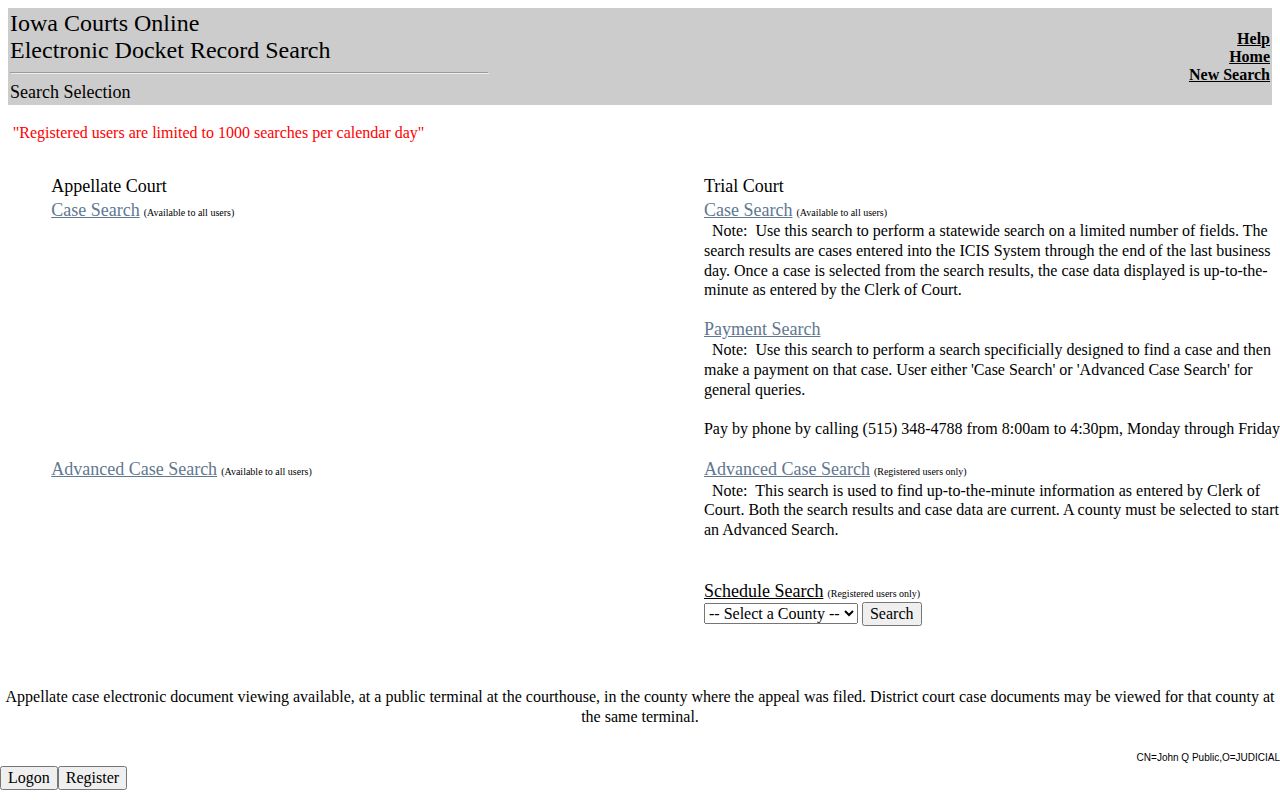
First, save the case number and county. Then pull the current docket entries to see where the matter stands today.
Where Iowa Busted Records Go
Every record stays with the agency that made it, even as a person moves through custody. Knowing the stage points you to the right source. It never promises a photo online. One name can surface in several agency files, because arrest, booking, court, and custody are separate events.
| Person's status | Best record path | What it can answer |
|---|---|---|
| Just booked or in county custody | County roster, jail portal, or booking request | Current custody and fields the county chooses to show. |
| Released or transferred | Original jail and arresting agency | Existing booking or arrest records; the person may have dropped off the roster. |
| Case filed or resolved | Iowa Courts Online, then clerk file if needed | Procedural events and disposition, subject to access rules. |
| State prison or covered supervision | IDOC public offender search | State status and profile information, not a new county booking. |
| Federal or immigration custody | Federal locator | Only the locator's defined population and time range. |
"Not found" has many meanings here. It could be a short web window, a transfer, a spelling difference, a confidential entry, or a system that is not public. Silence does not mean no arrest happened. Ask the custodian for your date range and field, then weigh the answer against the court docket.
Iowa DOC Search and Photo Limits
State custody runs through the Iowa Department of Corrections, or IDOC, which operates a public offender locator for people in state custody or under covered supervision. You can search first, middle, and last name. Offender number, sex, location, offense, and county of commitment narrow it further. That county is history, not a current address. Updates arrive weekly, and figures can shift fast.
What you get is an offender profile, not a county booking record. No photo appears in the public results or profiles. Iowa Code section 904.602 spells out the public data: name, age, status, location with a street-address limit, offenses, county of commitment, and physical description. A photograph is absent from that list. IDOC can still tell you, on request, whether a specific image exists and is releasable.
The IDOC offender search form takes a name or offender number to filter the state-custody record.
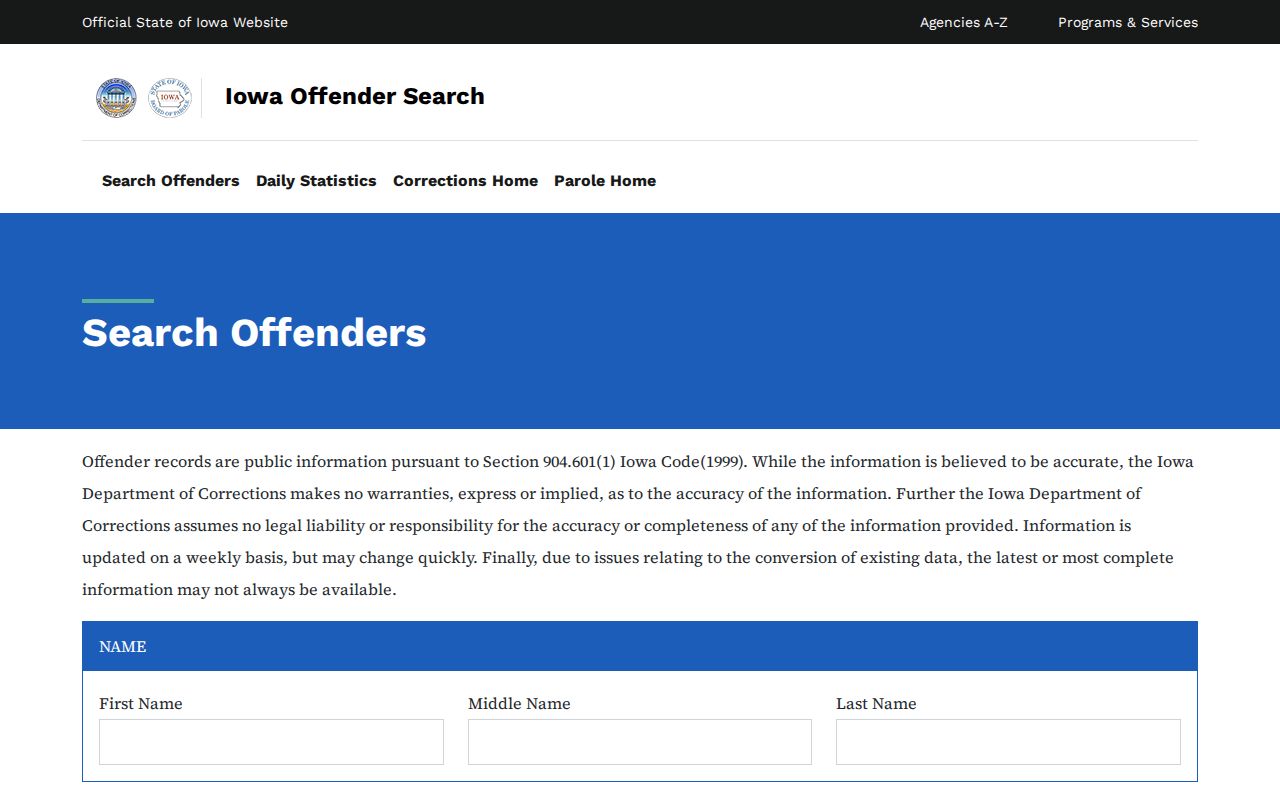
Match several identifiers, then read the current status, location, and dates before trusting a profile.
Iowa Warrants and Wanted Lists
The IOWA System is a police network, plain and simple. It offers no public statewide warrant search. Each sheriff's warrant page is a local tool. Its scope and freshness must be confirmed with the issuing office. A wanted-list entry is not a jail booking, either. Old notices can linger after a status changes.
To verify a warrant, pin down the county or court tied to the case. Check a verified county source if one exists. Then confirm with the sheriff's warrants unit or the clerk. Iowa Courts Online surfaces public case details, though some warrant matters stay confidential until service. An attorney or the issuing court settles open questions. Never approach or detain anyone named in a notice.
The registry's "most wanted registrants" list is a compliance feature, not an arrest index. IDOC posts incident-specific escape and abscondence notices instead of one stable roster. U.S. Marshals pages show selected federal fugitives only. Call 911 for an immediate threat, and use the tip route in the official notice otherwise. The official Iowa Sex Offender Registry keeps registrant searches and compliance notices separate from county booking records.
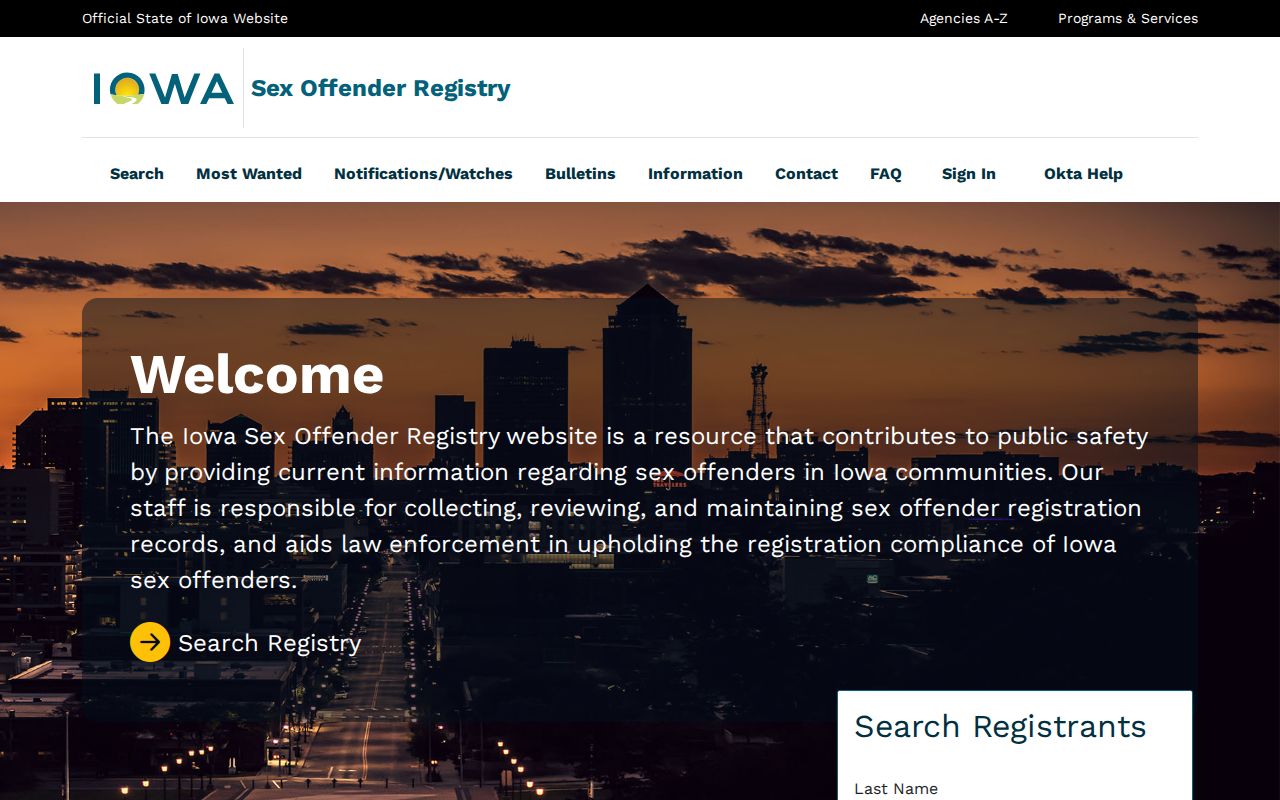
That "most wanted" feature stays focused on registry compliance. Arrest questions need a county or court source. Meanwhile, IDOC's official IowaVINE page describes a notification service covering release, discharge, escape, death, or unusual status changes.
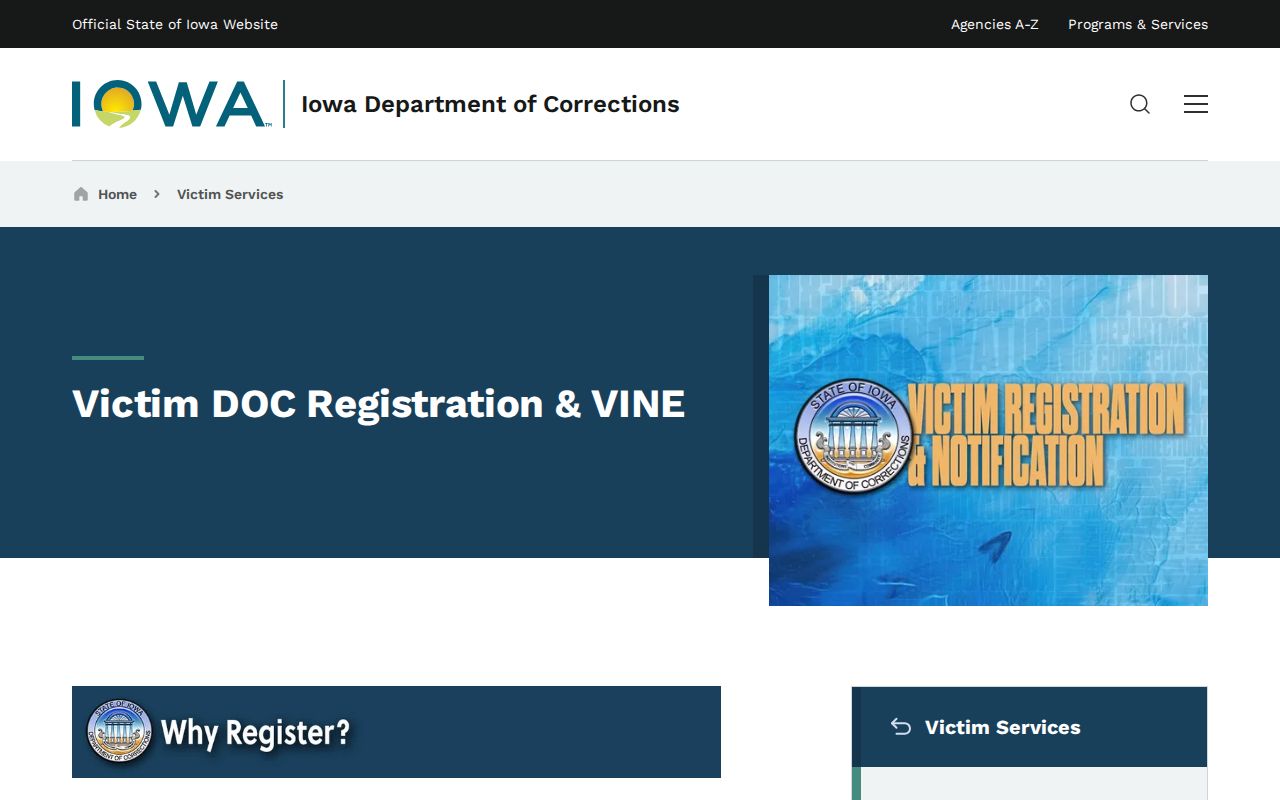
Alerts track a custody change well. They will not hand you an old booking photo or a court disposition.
Iowa Third-Party Arrest Pages
Commercial arrest sites are secondary indexes, nothing more. County coverage runs incomplete, with short rolling windows and inconsistent photographs. Duplicate and mistaken entries show up too. None of them carries a reliable statewide disposition record. An empty page doesn't mean no booking happened. A photo there proves neither its agency source nor its currency.
Busted Newspaper, RecentlyBooked, Mugshots.com, Arrests.org, and Mugshots.zone all run Iowa or county routes. Treat every one of them as secondary to the official county, court, and state records that actually hold the file. Some publishers offer a voluntary free fix for a wrong person, a juvenile, a sealed case, or a qualifying disposition. Rules differ, and accurate live entries may stay up. A publisher form is not an Iowa legal duty.
For an old or contested entry, start with the record custodian and get the case outcome. Then try the publisher's free process if it fits. Keep the exact page address and your official proof. Skip anyone charging to erase a public record. Iowa law creates no general pay-to-remove remedy.
Newsrooms publish selected arrest, trial, and sentencing stories, not a full statewide booking feed. Their pictures may be agency-supplied or editorial shots rather than intake photos, and any later court outcome deserves its own check.