
Where Old Iowa Mugshots May Survive
An old mugshot search is archive work, not a roster lookup. Iowa's state collections hold penal-institution records. The University of Iowa keeps a Fort Madison Penitentiary collection with mug shots and identification cards. County jail photos travel a different path. A sheriff may still hold an older booking file, may have transferred it under a local schedule, or may have destroyed it through an approved process. So the first questions matter. Which institution held the person? A state prison register is never a county booking log, and a court file proves a case date rather than holding the photo. The arresting agency or jail is the better custodian for an intake image.
Iowa's archival catalogs are finding aids. They describe record groups and series. They do not confirm that every name or image is indexed. The statewide trail shifts over time. A fresh arrest may still sit on a county roster or booking feed, while decades-old prison material rests in an archival collection. Old county images have no guaranteed destination. Any survival claim should be confirmed with the record creator and the named repository.
Iowa Archive Collection Inventory
Pick a route by collection name, era, and custodian. A catalog entry never promises that one person's photo survives.
| Collection or record | Where and likely era | How to begin |
|---|---|---|
| RG 097, Board of Control | SHSI institutional records and registers, about 1900–1970; indexed men's registers, 1916–1970. | Search by institution and series; note a volume or page. |
| RG 043, Governor | SHSI criminal, clemency, parole, discharge, and extradition files; dates vary by series. | Identify the series, case context, and access terms. |
| Fort Madison Penitentiary Records | University of Iowa Special Collections; most described items date from 1866–1965. | Use the finding aid and ask about the item or series. |
| Digitized prison registers and cards | Selected SHSI registers, Bertillon cards, and mug shots; coverage varies. | Check the catalog and digitization notice; the set is not complete. |
| Local booking and court files | County sheriff, jail, city police, or the court clerk; schedules vary. | Ask whether the item was kept, transferred, or destroyed. |
| Historical newspaper editions | Daily Iowan scans cover older campus and Iowa stories. | Use a story as a lead to the agency or court record. |
Local jurisdictions are listed in the Iowa County Directory. Confirm the city, county, or institution before requesting a record.
Iowa State Archives: RG 097
RG 097 covers state penal-institution registers. It also holds population reports and indexed penitentiary or reformatory records. A register can give a name, date, and volume. Not every entry has a photo. Check the RG 097 finding aid for series and dates, then cite the volume or page in a request and ask whether the item can be copied.
The State Archives RG 097 catalog entry lists institutional record series along with their research context.
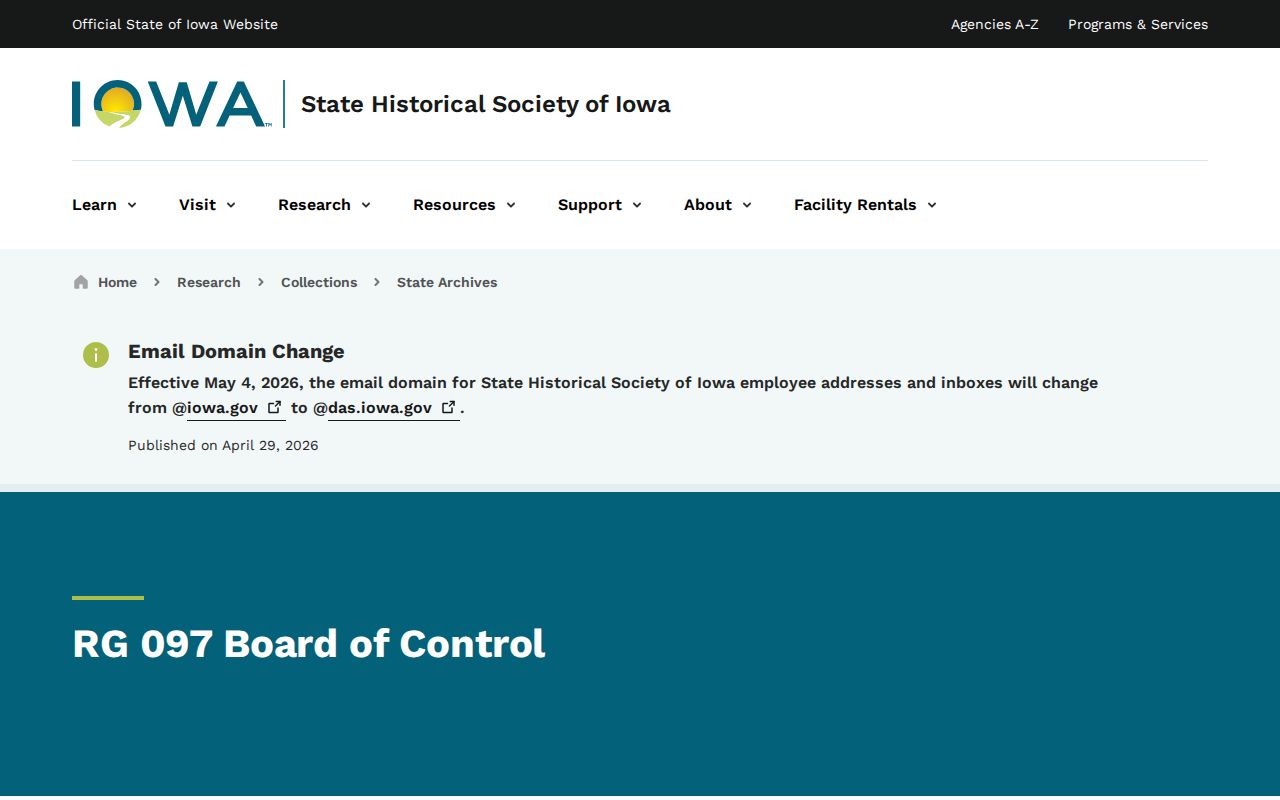
This finding aid describes state records only, so it does not reach every county jail calendar or intake image.
Iowa RG 043 Governor Records
RG 043 holds criminal and life-inmate material. That includes clemency, parole, discharge, and extradition files. It documents later state action rather than the original county booking. The RG 043 finding aid shows dates and series limits, and staff can say which details will identify the file before a copy is ordered.
Iowa Fort Madison Mugshot Records
Fort Madison's collection sits at the University of Iowa. It spans Bertillon cards, court records, and mug shots, with the cards serving as historical identification records. Most described items date from 1866–1965. The collection is open for research. Use the finding aid to identify a series, then give Special Collections a name, likely years, and institution. A catalog title is not a name-level result, because this is a university collection rather than a county roster.
The University of Iowa Fort Madison finding aid describes the Bertillon cards, court records, and mug-shot series inside the collection.
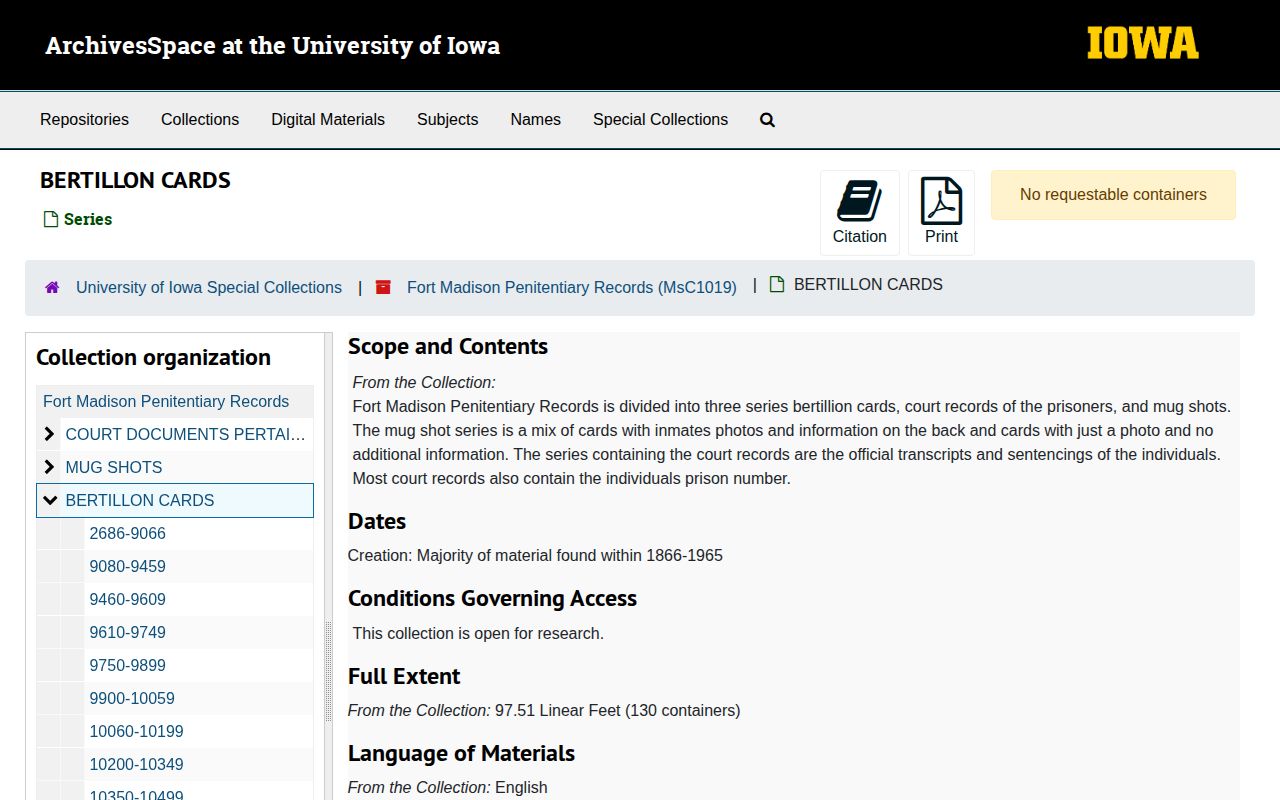
Ask whether the item exists, is legible, and can be copied by staff. The finding aid promises no digital image.
Digitized Iowa Prison Records
SHSI has digitized selected state prison material. Through an Ancestry partnership, the work covers convict registers, Bertillon cards, and mug shots. The announcement describes the material in detail. It is not a full jail-photo index. The Daily Iowan archive can date older campus or regional coverage, but a newspaper scan is an editorial copy rather than the original booking record, so cite the publication and seek permission before reuse.
IDOC Older Prison Records in Iowa
IDOC policy AD-CR-01 governs old prison files. Files released before August 1, 2012 route to an Iowa Medical and Classification Center repository. The rule covers state prisons only. It says nothing about county jail photos, and it does not promise that every former prisoner's file is there. For someone discharged at least twenty years ago or who has died, the policy describes keeping or imaging selected items, along with personal history. Selected items include fingerprints, judgment and sentence, and photos. Other file material may be shredded. Read AD-CR-01 for that distinction, or send an open-records request with the name, date range, and item sought.
The Iowa Department of Corrections open-records page explains how to submit a request for any IDOC-held record.
For current state custody, IDOC runs an offender-search locator. It is not a historical photo archive. A missing name on that weekly search does not prove the person was never in state custody.
Iowa Booking Photo Retention
Iowa sets no statewide rule for how long county jails keep booking photos. State schedules reach state agencies and named series only. County files answer to local rules instead. A vendor contract, legal hold, or disposal approval can override any default. One older rule cites two years for a jail calendar and certain records. That holds unless another schedule applies. That is no photo mandate. Ask the creator for the series name, the schedule, and whether the item was kept, transferred, or destroyed. The SHSI schedule covers state records, so county practice must be checked locally.
Request Iowa State Archives Records
Gather the basics first. You will need the person's name, the institution, rough years, the record group or series, and the register page or image sought. Add a case number only if you know it, since a narrow request is far easier to search than every record tied to a name.
- Search the finding aid and note the record group, series title, institution, and dates that fit.
- Submit a reference request with the name, approximate period, and the specific register, page, or image sought.
- Ask whether the item can be copied, whether a visit is needed, and whether restrictions or fees apply.
- Wait for an estimate before ordering extensive research or copies, then confirm the scope and delivery method.
The reference unit acknowledges requests within five business days. Extensive work may take weeks. Book appointments at least five days ahead. A fee can apply to deep research, with an estimate provided first; use the State Archives reference-request page for the current form and request route.
The SHSI reference-request page is the official place to start an archives search.
Iowa Archive Copy and Image Fees
SHSI posts separate fees for copies, certification, digital images, and publication. Small photo requests may ship by email for free. Research, high-quality scans, and publication rights cost more. The copy and image rules list current fees, copyright terms, donor limits, and reuse rights, while county charges stay separate, so ask the local custodian for an estimate.
Which Iowa Records Survive?
A catalog entry proves a series exists. It does not prove your person appears in it. A register may hold no photo, and an image can be unindexed, restricted, damaged, or too faint to copy, so staff must check the item itself.
State collections can hold prison material missing from any current website. They do not own every local arrest photo. Ask the sheriff or jail where its series went. If destroyed, request the schedule and disposal record. If it moved, get the receiving repository and catalog reference; if it stays, ask whether chapter 22 permits access.
Current Iowa Records Stay with Counties
A roster shows current custody only. A feed may cover a short booking window. A released person can drop off the roster while a booking sheet or court file survives. Use the Iowa arrest and booking lookup for current county routes, and for an old file, ask whether it was kept, transferred, or destroyed. The creating office holds that answer.