
Iowa Mugshot Records: The Short Answer
The starting point is Iowa Code chapter 22. Wait: that link belongs later. The starting point is Iowa's public-records law, chapter 22, which lets anyone examine and copy qualifying records unless another law or court order blocks access. A booking photo held by a sheriff or jail may fall under that right. The law stops there. It never forces an agency to run a live roster or post images. Plenty of records exist off the web, sitting in a file cabinet instead. So the practical answer depends on who created the photo, how the record is classified, and whether an exception applies. A private listing site proves little. It cannot show what an agency would hand over today, and it often skips the court outcome entirely.
Iowa Public Records Under Chapter 22
Iowa Code chapter 22 grants the right to examine and copy public records, and to share what you find. Section 22.2 does not oblige a sheriff to maintain an online roster. That step stays optional.
Section 22.7(5) shields peace-officer investigative reports. Still, basic facts stay open. Date, time, place, and the immediate circumstances remain public unless release would jeopardize an investigation or create a clear and present danger. Each record needs its own review.
Section 22.7(9) protects criminal-identification files. Yet the same section declares arrest records and criminal-history data public. A booking photo might live in a different record series entirely. When you file a request, name the item, the agency, and the date.
Iowa Chapter 690 and Mugshots
Iowa Code chapter 690 covers fingerprinting for serious misdemeanors, aggravated misdemeanors, and felonies. Photographs and palm prints fit within that process too. Posting photos online is another thing entirely. Nothing in chapter 690 orders it.
A roster with names only proves nothing either way, and a photo may still exist behind the counter. Ask the booking agency directly whether it holds an image. Also ask how the record is classified, and why any part would be withheld.
- Booking
- The intake process after an arrest, including identity and custody records.
- Disposition
- The court's recorded outcome of a charge or case.
- Expungement
- A legal process that makes an eligible court record confidential under Iowa law.
When Iowa Records Can Be Withheld
Juvenile records follow a different path. Iowa Code chapter 232 keeps child-in-need-of-assistance records and most delinquency records confidential. Narrow exceptions exist for authorized people, certain serious offenses, or a court order. Sections 232.149 and 232.150 govern juvenile prints, photos, and sealing.
Adult records work differently. One investigation or safety order can shield a single item while basic facts stay open. If an office withholds something, ask which law it relies on. Also ask whether part can be released. "Not online" never means "illegal to release."
Iowa's Mugshot Roster Rule at IPIB
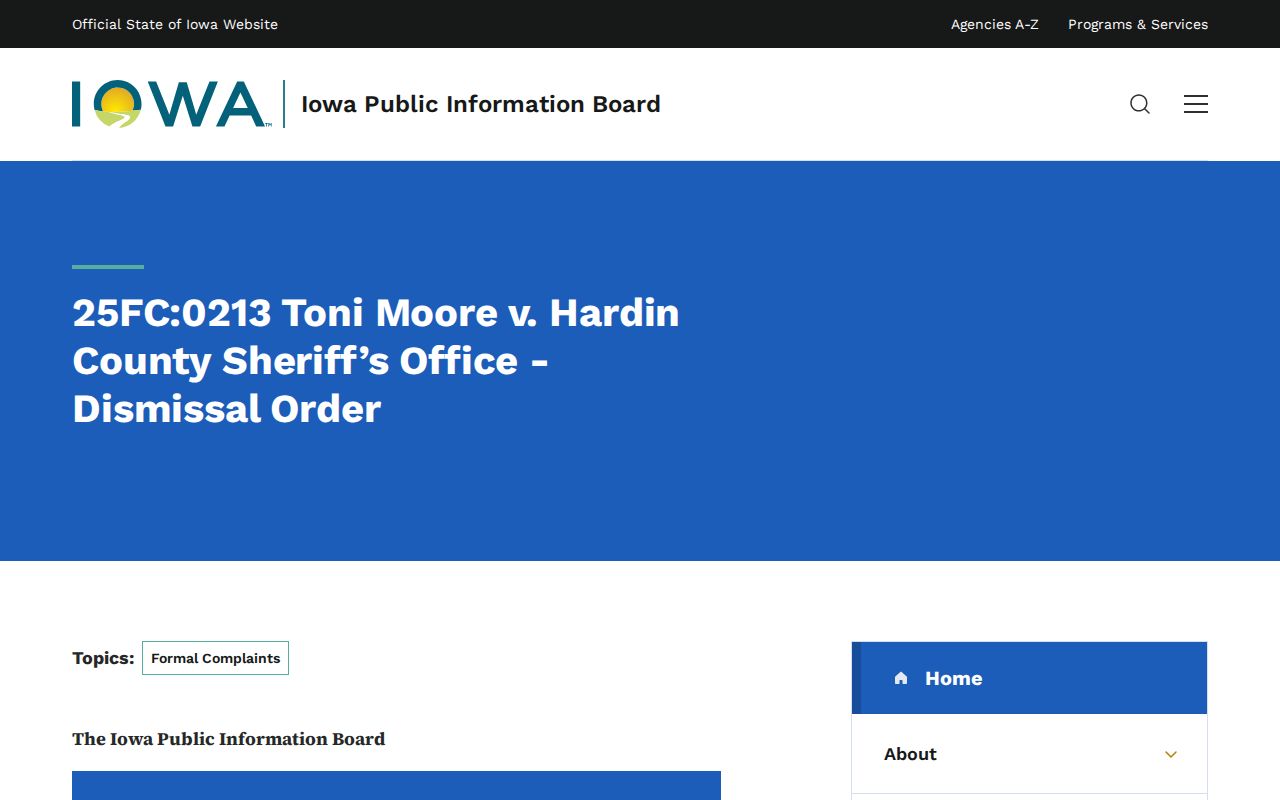
Consider Toni Moore v. Hardin County Sheriff's Office. There, the Iowa Public Information Board weighed the question. It held that chapter 22 does not force a sheriff to keep a continuously available online roster. An office must still respond to requests for records it holds. It need not build a new web product for the public.
The dismissal order settles no bigger question about whether photos are public or private. It does explain one thing well. A blank roster search is not the end. Your request can still proceed.
The IPIB's Hardin County dismissal order gives the board's official reading of the roster question under chapter 22.
Vaccaro v. Polk County turned on the section 22.7(5) investigative-report exception. The Iowa Supreme Court reversed. It sent the case back for a review tied to each record and its circumstances. The case had nothing to do with paying for mugshots. It set no general photo rule either. Still, the Vaccaro opinion warns against blanket answers to every request.
Where Iowa Booking Records Live
Begin with whoever created the record. A sheriff or jail roster may confirm current custody. The arresting police department may hold the incident report instead. Remember that a roster drops people after release or transfer, and it never shows the court result.
| Record route | What it can answer | What it cannot prove |
|---|---|---|
| County roster or booking feed | Whether a person appears in the operator's current or recent booking view. | A complete statewide arrest history or final case result. |
| Agency records request | Whether an existing booking sheet, image, or report is held and releasable. | That every requested item exists or can be copied without review. |
| Iowa Courts Online | Public case and docket entries for court follow-through. | A booking-photo archive or the full official clerk file. |
| IDOC offender search | State correctional custody and covered supervision. | A county's fresh booking feed or a public offender-photo archive. |
The Iowa arrest and mugshot lookup compares county rosters and feeds in one place. For state custody or supervised release, try the IDOC offender search. The public locator displays no photos. That does not mean IDOC keeps none in its files.
A court case changes the picture. Note the case number and read the later docket entries for the outcome. Iowa Courts Online opens case information to the public. It is not a booking-photo source, though. It also does not replace the full clerk file.
Request an Iowa Booking Photo
Help the custodian find the file. Give a name, an approximate booking date, the agency, and the specific item you want. Request the booking sheet and photo separately, along with any booking number, intake charges, booking or release time, and bond record that exists.
- Send the request to the agency that made or maintains the record. If the arresting office and jail are different, ask each office for the record it created.
- Request an electronic copy and ask the custodian to identify the record series and any fee estimate before chargeable work begins.
- If any part is withheld, ask for the statute or order relied on and for any portion that can be separated and released.
- Keep the response with the case number and date. If the record itself is wrong, ask its original custodian to correct the source record.
Iowa's open-records law lets a custodian charge reasonable fees. Copying, locating, and staff review time all count. There is no single statewide mugshot fee, so each office sets its own. Ask for an estimate up front, and request an existing item rather than a fresh list.
If the answer is no, the office should tell you why. Get the statute or order it relies on, a reason for each record withheld, and any portion it can release. Save the reply and note the date you asked. The IPIB's chapter 22 guidance walks through the process; a real dispute may need case-specific help.
State-prison records follow a separate IDOC path. A county booking photo stays with its local custodian.
Start with the Iowa Department of Corrections request page for any record IDOC holds.
Ask the county about its retention schedule. Iowa sets no single jail-photo period, so an old image may sit in storage, have moved elsewhere, or been destroyed under local rules.
Iowa Mugshot Records After Dismissal
Acquittals and dismissals have a statutory path. Iowa Code section 901C.2 sets a duty for courts. They must expunge eligible records once the conditions are met. All court costs and financial obligations must be paid first. The usual wait is 180 days. A good-cause waiver can shorten it, and other limits apply.
Once expunged, a court file becomes confidential. Chapter 22 generally no longer opens it, though authorized access continues. Track the current Iowa court forms, the docket, and the order. Deferred judgments work differently. Section 907.9 may allow closure or expungement after successful completion. But it is not automatically a dismissal.
The court packet lists every filing step and attachment. Follow the instructions for the case, including any criminal-history form. The clerk can explain fees and exceptions. Eligibility turns on the case and order, not on an old publisher page.
| Route | What may change | Key limit |
|---|---|---|
| Acquittal or dismissal, §901C.2 | An eligible court record becomes confidential after the conditions are met. | All charges, payment duties, waiting time, and exceptions matter. |
| Eligible misdemeanor, §901C.3 | A qualifying conviction record may be expunged after the statutory wait. | No pending charge, paid obligations, offense exclusions, and a generally one-time limit apply. |
| Deferred judgment, §907.9 | Successful completion may allow court closure or expungement. | It is a distinct outcome, not the same as a dismissal. |
Iowa Misdemeanor Record Expungement
Section 901C.3 reaches certain misdemeanor convictions. The wait runs past eight years. The person must face no pending charge, satisfy payment rules, and clear the offense exclusions. The route is generally a one-time option, and the full case history controls what happens.
Keep a signed copy if relief is granted. These court rules create no duty for a private publisher and wipe no old search results.
Iowa Mugshot Records After an Order
An order reaches only the records it names. It will not erase a sheriff file, news story, private copy, screenshot, cache entry, or search result on its own. Every custodian keeps its own record and process.
Send the order to the agency or publisher. Ask each to apply its rules. For a wrong person, a duplicate, or a missing disposition, cite the exact page and case number with only the proof needed. Once a source changes, ask a search service to refresh its stale result. Total internet erasure is not something anyone can promise.
Iowa Mugshot Publisher Policies
A private publisher may remove, suppress, or update a listing under its own policy. That is a choice, not an Iowa statute. Terms can shift at any time. An accurate record can stay online even after a favorable outcome. These routes are voluntary. They bind only the publisher named in the request.
| Publisher route | Policy described in the Iowa research | Practical limit |
|---|---|---|
| Busted Newspaper request | No fee is stated for qualifying requests based on expungement, dismissal, acquittal, sealing, an error, or a wrong person. | Its form asks for the exact URL, name, email verification, reason, and proof; review is commonly five to ten days. |
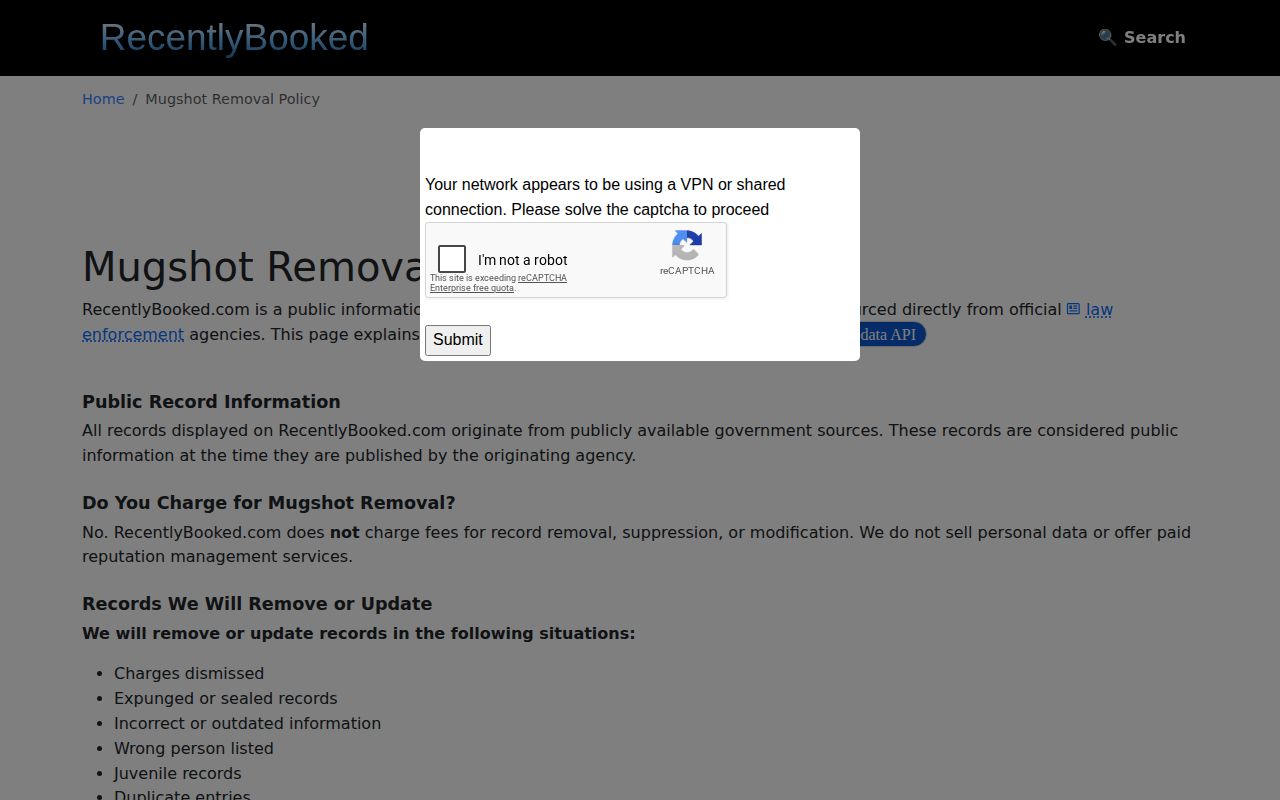
| RecentlyBooked policy | No-fee requests may seek removal, suppression, or changes for dismissal, expungement, sealing, errors, wrong people, juvenile, or duplicate records. | Give the URL, name, date, county, reason, and proof; accurate live information may remain. |
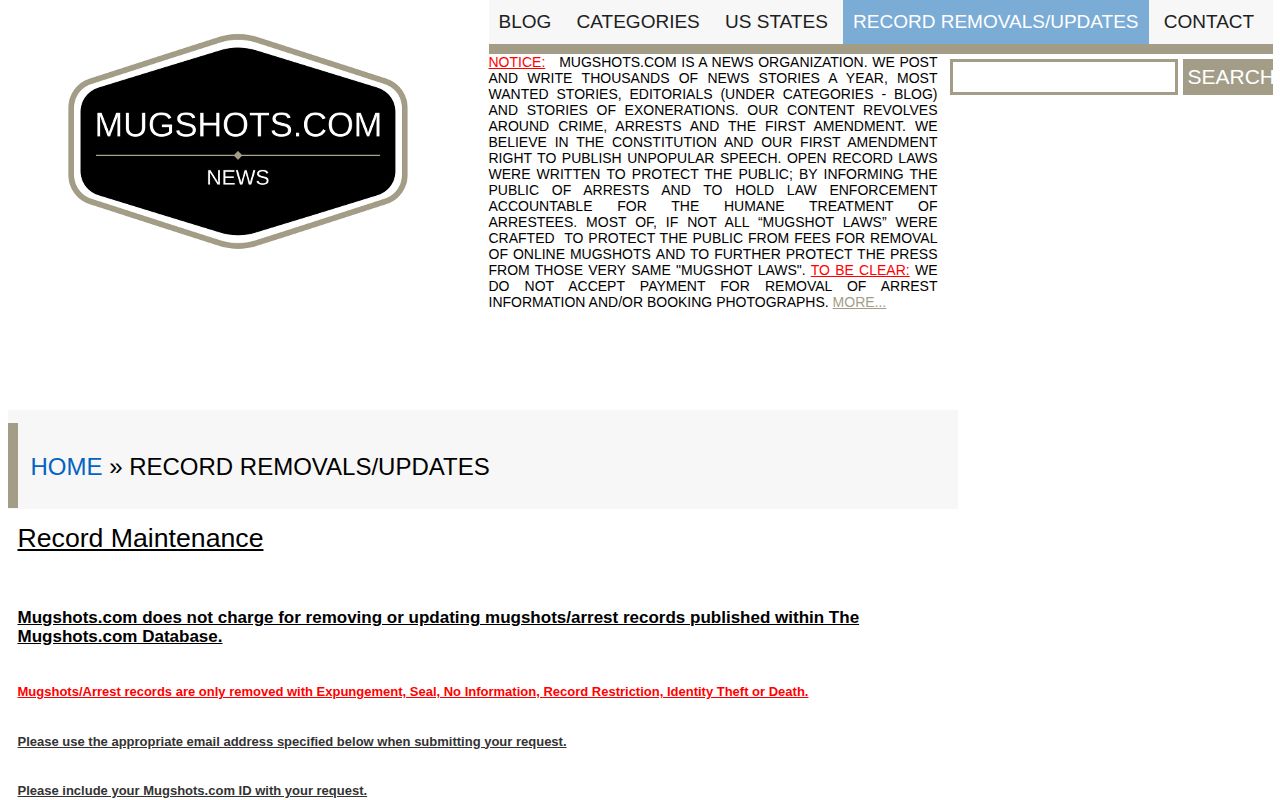
| Mugshots.com record maintenance | Free requests cover listed grounds such as sealing, expungement, identity theft, or no information. | Use its record ID and proof; an outcome may be an update, and review can take up to ten business days. |
A private policy proves nothing about a photo's accuracy. Recheck the rules before sending proof, since forms and response times change.
The RecentlyBooked policy page lays out its free request path and the records it may update.
The Mugshots.com record-maintenance page lists its stated no-fee request grounds and record-ID process.
Iowa Mugshot Removal Law
Iowa has no enacted law that generally bars agencies from releasing booking photos. Nothing requires online publication either. No state statute makes a private publisher remove a truthful listing for free. A narrower law or a specific order could still govern one record. Iowa's appellate courts have set no statewide commercial removal rule.
House File 2309 tried a different route. It proposed photo confidentiality with exceptions for law enforcement, public safety, court orders, or a conviction or plea. The bill drew activity but never became law. Its official history shows where it stalled.
No Iowa law makes a paid middleman necessary. Start with the custodian, a court order, and any free publisher process. A free request can be denied. Payment is still not a legal prerequisite.